Tag Archives: Geoffrey Sirc

COVIDucation

empty1
Photo by Calvin Tran

We all fled to our homes, with little warning, and certainly without a clue that we’d never be gathered as a class, this class, ever again.

We spent the first few days with our families, figuring out what this new normal looks like and scouring stores for toilet paper.

Then I reached out to my students, by email, by video conference, and planned out enrichment activities while my school district figured out what schooling while sheltering at home looks like.

No one knows.

But I knew where to start trying to figure it all out—A New Culture of Learning: Cultivating the Imagination for a World of Constant Change by Douglas Thomas and John Seely Brown. I’d read the book years ago and it’s been infecting my craft in all the time since. Infecting, because it burrowed itself deep into how I teach, how I motivate my students to learn.

I worked backwards in my re-reading, starting with the last two paragraphs:

“That moment of fusion between unlimited resources (referring to the internet) and a bounded environment creates a space that does not simply allow for imagination, it requires it. Only when we care about experimentation, play, and questions more than efficiency, outcomes, and answers do we have a space that is truly open to the imagination.

And where imaginations play, learning happens.”

Right now, world, state, and local political leaders, public health officials, and the medical community should be concerned with “efficiency, outcomes, and answers,” but teachers, thrust into remote education without a bit of training, have a responsibility to the students we serve to lead them to learning by creating a flexible space where “experimentation, play, and questions” reign. 

A space where students can continue learning while living in a world upside down, radically different than any of us have ever experienced.

What might this look like?

Different for every teacher, every subject, as they respond to the needs of their students. For me, a writing and journalism teacher, I stripped down my syllabus to four lines from Mary Oliver’s poem “Sometimes”:

Instructions for living a life:
Pay attention.
Be astonished.
Tell about it.

I would hope all teachers, no matter the subject, would be able to make that subject applicable to students’ lives as they’re lived, right now.

So what might be the results of my four-lined syllabus, one that prioritizes questions? Well, I just revised it, so it will take some time to see what students come up with, but I do have a few early examples.

Camelia let herself be astonished by the sound of falling rain.

Sandra tweeted how she has “really found some courage in myself,” hoping she “can confidently express [herself] without any worthy.”

Anna wants to break out her old analog, film-based, SLR Minolta camera to “document how the world has changed during COVID-19.” You see, she’s astonished by how people have changed, how their relationship to each other and their environments have changed, and she’s going to use that camera to pay attention. I can’t wait for her to tell about her findings.

Then there’s Justin, who, upon listening to an episode of John Green’s The Anthropocene Reviewed podcast, was left “grappl[ing] with the nature of luck, merit, and fairness.” And so the 10 minutes of writing I asked students to do after listening to the podcast turned into 14 pages and 10 graphs, “pseudosystematic visuals that helped give shape to [his] ideas.”

Had I been concerned with trying to re-create an exact (and efficient) virtual replica of my brick and mortar classroom, expecting exact outcomes and answers from students, dangling a reward (points, a grade) over their head, they would’ve checked the box and moved on to what was more pressing in their life.
infinite expansion

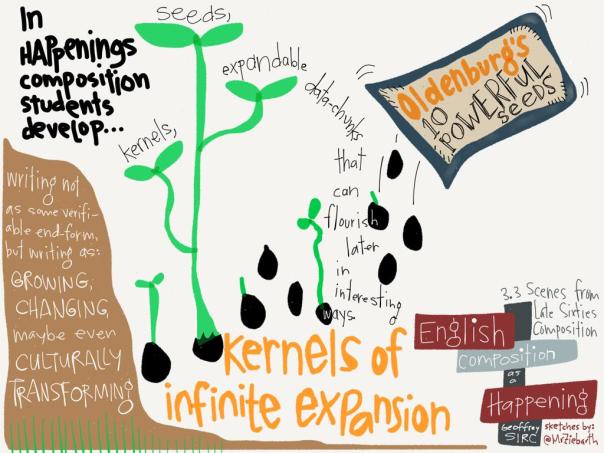
But because I gave them, hopefully, a purpose to their learning, to live a life, their life, they experimented, they played, they learned. Learning “not as some verifiable end-form, but [learning] as growing, changing, maybe even culturally transforming” (Geoffrey Sirc).

There’s no way every student will be moved to write for hours like Justin did, and I don’t expect them to. But I hope to lead them to discover for themselves “kernels of infinite expansion” that will “flourish later in interesting ways” (Sirc) and motivate their learning for years.
What Are You Doing About It?

image.jpg

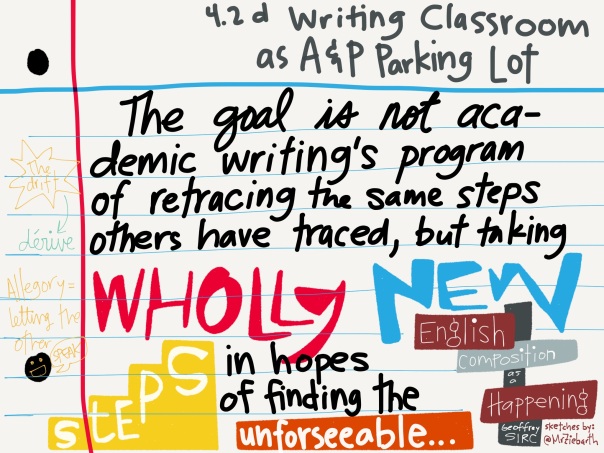
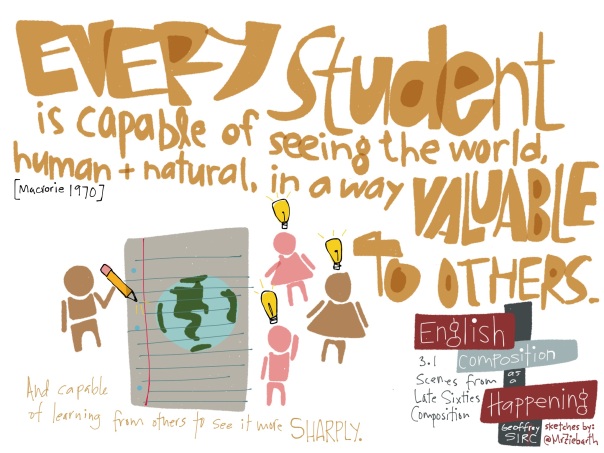
After seeing the above sketch in her Twitter feed a couple months back, my good friend and teacher-neighbor across the field, Seena Rich, sent me this response:

While she did so gracefully, Seena was calling me out, challenging me, asking me to put my money where my mouth is.

What she wanted to know was: Ziebarth, I’ve been watching you tweet out all your little doodles about that book you read over the summer, so what?!? What are you doing about it?

Up to that point I hadn’t committed to doing anything about my reading other than tweet out the sketches of it. Probably because my head was spinning with ideas, but a book like English Composition as a Happening needs some time to settle, digest, sink in.

I’m grateful for friends and colleagues who push and challenge my thinking, my practice, who get a little antsy when I’m just tossing bread crumbs to the world. Seena’s tweet started me thinking … What have I learned? What is my big takeaway from Sirc’s book?

Respect.

Respect for what my students have to say.

Respect for their voices.

Respect for my students as writers.

Respect for the journey my students are on as writers.

Respect for my students as human beings.

image.jpg

What’s curious is that I’ve been changing my composition course every year, bit by bit, as my students teach me every year that they deserve and are worthy of my respect.

What this respect looks like in my classroom (and the changes Sirc inspired) is ongoing, and like Deemer says, there is no blueprint. Happenings happen. Teachers must inspire their own. Regardless, I hope to explore mine here in the near future. Stay tuned.


The Catcher in the Rye: a blacked-out novel

I’m crazy / I’ll be bored and dance / I get a bang for dancing all over / It’s in my blood / It gives me suspense / by Alyson

About a year-and-a-half into my teaching career I cribbed an in-class activity from Austin Kleon: newspaper blackout poems. But I didn’t want to do them exactly like Kleon. I wanted to tie it closer to my curriculum. At the time I was teaching juniors and freshman, and among lots of other things we read The Catcher in the Rye and Fahrenheit 451 at those levels, respectively. So I scratched out “newspaper,” replaced it with “novel,” and armed my students with black Sharpies, crayons, Crayola markers, anything I could get my hands on. Oh and of course they each had a couple pages from the novel we were reading.

I love poetry but I never actually write it, so this was an interesting way to try it out. —Melissa

I especially like the prompt I gave my freshmen students who were reading Fahrenheit 451. At one point in the novel, the protagonist, Guy Montag, is running from the police who are recording the pursuit and Montag imagines himself being caught and wonders what he could say, with millions watching, “in a single word, a few words, that would sear all their faces and wake them up.” So I instructed my students to imagine themselves in Montag’s place and come up with a blackout poem, boil down words from the novel into something, that would get everyone’s attention, that would shake everyone out of their comfortable numbness.

Here are a couple examples from that first year:

"Books are friends not your enemy."
“Books are friends not your enemy.” By Giang
“A lifetime of books well hidden are no use to our world.” By Travis

Kleon himself says he struggles with teaching people how to create a blackout poem and as you can see from these examples, my first attempts at teaching them varied widely, visually at least.  While different students put a little more care into how they looked than others, each of these 9th grade boys created poignant little poems.

I shared my student work with Kleon who generously posted it along with my presentation to his website. The students were thrilled. Six years later and students are still impressed by that. It just goes to show you how hungry students are to break out of the classroom walls once in a while. It’s never enough really.

I felt like this blackout poem was really different from what we have been doing, so it felt pretty nice to do something new. —Hannah

See?

After using blackout poems for a few years I wanted to do more with them, “plus one it” as my friend David Theriault likes to say. Year after year, I’d pass out the same two pages from the novels and frankly, I grew tired of looking at the same source material, so a couple years ago I decided to hand out different pages to each student. Then the idea struck! Why don’t we collaboratively black out an entire novel?!?

That’s exactly what we did. It’s a bigger project than I first imagined, so it’s taken my students and me a couple years to complete. They did their part. It took some organization and focus on my part to bring all the student work together and even then I needed my students’ help and so a few of them stepped up during the last week of school this year and helped me scan, tag, and queue our first blacked-out novel: The Catcher in the Rye.

At present, we’ve posted just under half the novel. I’ll continue to post one poem a day until we exhaust the pages. Then what? Well, we’ll start working on another novel. Probably one of the more hefty novels we read: The Scarlet Letter or The Grapes of Wrath.

On a pedagogical note: I don’t use a rubric for this assignment. I show them this presentation, student examples, then I give them the prompt: “create a blackout poem that represents one way YOU see the world.” As you can see by the main image for this post, students take the directions “black out” with a grain of salt. And I like it that way. I want these pieces to be dripping with each students’ voice and tone and self.

Even with very few criteria, some students still struggled with the assignment. Some felt limited by the criteria—

I was really into it…until the poem had to be about how I saw life. This became an obstacle. I was struggling to find something to put together. Especially with the page. I had I wasn’t able to really put something together until I forced myself to pick out something. It later became an assignment more than a work of creativity for me. —Victor

Victor’s words sting! I want to let students roam free with this assignment. Victor wanted to be free, but others might need a little more guidance, more limits. It’s an easy problem to solve. Make the criteria optional!

Lest anyone think this is a frivolous activity, well, let’s agree to disagree. I think we need more frivolity in education and many happen to agree. I’m still not frivolous enough! One of my playmates/mentors whose work reminds me of this fact is the ever fabulous Amy Burvall.

So that second link above is to a book I’m reading this summer by Geoffrey Sirc who argues that composition classes should look more like art classes, and he uses Duchamp, Pollack and other artists from the 60s’ Happening movement as models for what that might look like. I see novel blackout poetry as one take on Sirc’s “Student-as-Jackson-Pollock allegory. He quotes Robert Goodnough who says the composition classroom should not be “concerned with representing a preconceived idea, but rather with being involved in an experience of paint and canvas, directly.” Novel blackout poetry encourages students to “just put stuff together” (Sirc) and is a way of writing “which, ” John Cage says “comes from ideas, is not about them, but which produces them.”

Take this 16-year-old’s idea for instance:

They said I’m a smart girl / I said I wanted to stay a moron / Because I’m too young to be this sad / by Lindsay

It was like a blank canvas, except it was already filled in and you picked the things that you liked. —Trang

Novel blackout poetry employs new techniques of composition that Sirc calls for, that networked knowledge demands: “appropriating, sampling, copying, cataloging, scanning, indexing, chatting, and audio/visual streaming.” Sirc’s compositional ideal is Duchamp’s “chosen, pre-manufactured readymade.” And my students are obviously from the neo-readymade generation:

I like how the blackout poem really embodied the idea of creating your own work from something that was already written. —Celine

Novel blackout poetry also aligns nicely with the Common Core standards. I can help you there too.

It did help me appreciate The Catcher in the Rye more and especially Salinger’s writing style because writing the poem gave me a better understanding of Salinger’s word choice and also how he fit all of his words and ideas together. —Jesse

So as Amy Burvall says, let’s: